
Calorie Deficit Calculator
Estimate average daily calorie deficit and intake to reach a target weight by a target date using Mifflin–St Jeor BMR and TDEE activity factors.
Omni's calorie deficit calculator helps you to estimate how long it will take to reach your target weight by following a given calorie deficit.
Are you struggling to maintain a healthy weight or trying to figure out why you always feel hungry and tired while on a diet? If you are, you have come to the right place. Continue reading this article to understand what calorie deficit means and how to calculate it. You will also find answers to questions like how much of a calorie deficit to lose weight healthily and how to eat in a calorie deficit.
Prefer watching over reading? Learn all you need in 90 seconds with this video we made for you:
What is a calorie deficit?
A calorie deficit is when you consume fewer calories than you burn. A calorie is a unit of energy, with 1 cal = 4.184 joules. Our body receives energy from what we eat and drink and spends this energy to perform every function essential to keep us alive, like breathing, digestion, blood circulation, etc. We also spend energy on every physical activity that we perform. We can put ourselves into a calorie deficit by providing our body with fewer calories than it needs to support these activities.
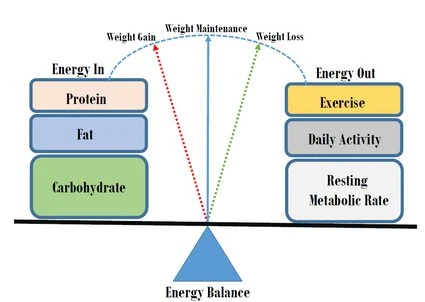
Figure 1: Energy balance chart.
Calorie deficit to lose weight
By maintaining a calorie deficit for the long term, you can lose weight. Now, you must be wondering how to be in a calorie deficit; the answer is simple. There are only two ways to maintain a calorie deficit:
Eating fewer calories than what you burn; and
Burning more calories than you eat.
It is always recommended that you combine both of the above for healthy weight loss. To calculate how much calories you burn in different activities, check out the calories burned calculator.
Remember that 1 pound (0.45 kg) of fat is about 3,500 calories. Hence, to lose 1 pound of fat, you need to create a calorie deficit of 3,500 calories.
This means that to lose 1 pound per week, you should consume3500 / 7 = 500
calories less than the number of calories your body needs per day.
To lose weight without significantly affecting your energy levels, you should aim for a calorie deficit of 500 calories per day.
In the next section, we will see how to calculate calorie deficit.
How to calculate calorie deficit?
The formula for calculating calorie deficit is:
calorie deficit=caloriein−calorieout
In the above equation, caloriein refers to the number of calories that we consume every day, either through food or drink.
The term calorieout is the number of calories that our body needs to maintain our current weight and activity levels.
If calorieout>caloriein, you are in a calorie deficit, and you would lose weight. If it is the other way around, i.e., calorieout<caloriein, you are in a calorie surplus, and you will gain weight.
Predicting weight loss in a calorie deficit – Is it really that simple?
The equation sounds simple enough, and one may think that just by eating very few calories, one can maintain a calorie deficit and lose weight. But it is not so.
For starters, if you eat too few calories, you will always feel hungry and tired. It will also slow down your metabolism and make losing weight difficult. You may start losing muscle mass, which is not good for your health.
Another crucial point is that everyone responds to a diet change differently, depending upon their metabolic health. So it is very difficult to predict individual weight-loss results accurately.
A simple trick is to figure out how many calories you burn every day and follow a calorie deficit of 300 to 500 calories for a healthy weight loss.
The number of calories that you burn every day, i.e., your total daily energy expenditure (TDEE), depends on several factors, like, sex, age, height, weight, body composition, and physical activity level. Our calculator uses the Mifflin St Jeor equation to calculate your basal metabolic rate (BMR) and then calculates your TDEE by taking into account your physical activity levels.
We then use this information to provide an estimate of the time it would take for you to reach your target weight by following your chosen calorie deficit.
Remember as you lose weight, your TDEE changes, and so does your recommended calorie intake.
What is my calorie deficit? – Using the calorie deficit calculator
If you are wondering what my calorie deficit is for a healthy weight loss, fret not! Let us see how you can use our calorie deficit calculator to help you find a solution to your problem.
Enter your personal information, like sex, height, current weight, age, and activity level.
Input your target weight and the target date (the day by which you want to reach it).
The results section will show you the estimated calorie deficit to reach the goal.
The calorie deficit calculator will display your body's calorie requirements for maintaining your current weight based on your current activity level.
It will also display a few charts:
Suggested calorie intake for the following weeks, with some recommendations for a calorie deficit diet; or
An estimate of your weight change over time for your chosen calorie deficit.
Finally, you can explore the table showing other healthy calorie deficit options to consider, with the number of weeks required to reach the target weight.
Note: This calorie deficit calculator does not take into account body dynamics and other complex physiological changes that occur when you are in calorie deficit.
How to eat in a calorie deficit?
It is vital to pay attention to what we eat or drink every day to create a calorie deficit. This doesn't mean that we should start depriving ourselves of food. We will only end up feeling miserable, hungry, and lethargic.
Therefore, we should try to eat food that is nutrient-rich but low in calories.
According to the dietary guidelines for Americans 2020-2025, a healthy diet should include:
Fruits and vegetables;
Plenty of protein such as eggs, legumes, nuts, seafood, or dairy products, etc.;
Whole grains; and
Healthy fat sources such as olive oil, nuts, etc.
In addition, we can also follow certain recommendations to reduce the calorie content of our meals, for example:
Avoid consuming too much sugar and trans fats;
Increasing water intake;
Eating more fiber; and
Switching high-calorie foods with lower-calorie food.
We recommend checking our IIFYM calculator to determine the optimal amount of nutrients you should consume every day. You can also use our water intake calculator to estimate your daily water intake.
FAQs
How to be in a calorie deficit?
To be in a calorie deficit mode, we should burn more calories than we consume. We can achieve this either by reducing the calories we eat and drink, or increasing our physical activity levels. Ideally, both.
How much of a calorie deficit to lose weight?
For healthy weight loss, i.e., 1 pound per week, a calorie deficit of 500 calories per day should be enough.
How long does it takes to see results in a calorie deficit?
To lose 1 pound of fat, we need to burn about 3500 calories. Therefore, assuming a calorie deficit of 500-1000 cal per day, you should be able to lose 1-2 pounds in the first week.
Can you build muscle on a calorie deficit?
Yes. Research has shown that it is possible to build muscle on a calorie deficit by following a low-calorie, high-protein diet.
What is a calorie deficit diet?
A calorie deficit diet is a diet that is low in calories and helps to maintain a calorie deficit. For healthy weight loss, it is always advisable to eat a nutrient-rich, high-protein, and low-calorie diet consisting of fruits, vegetables, healthy oils, lean protein, and whole grains.
Is it okay to eat less than 1200 calories a day?
No. Most of us need a minimum of 1200 calories per day to stay healthy. We also need the energy to perform our everyday chores and exercise, hence eating less than 1200 calories will be harmful to our health and also make us feel tired all the time.
How do I calculate calorie deficit with BMR?
To calculate calorie deficit from your basal metabolic rate (BMR), follow the given instructions:
Find out your physical activity level value; for a sedentary lifestyle, the activity level value is 1.2.
Multiply your activity level value with BMR, you will get your total daily energy expenditure (TDEE).
Subtract the TDEE from the total number of calories you consume.
If the above number is negative, you are in a calorie deficit.
Estimate how long it will take to reach your target weight and what average daily calorie deficit you need, using the Mifflin–St Jeor equation for BMR and standard activity factors for TDEE. . This is an estimate only; metabolism varies. Consult a clinician for medical advice.
Results
Calorie deficit to reach goal (average per day): 442 kcal over 122 days (~17.4 weeks), to lose 7.0 kg of fat mass (~53,900 kcal).
Estimated maintenance calories (TDEE at current weight): 2,265 kcal/day (BMR 1,462 kcal × activity 1.55).
Approximate daily calorie intake to hit that deficit if activity stays similar: 1,824 kcal/day.
Calorie intake plan
Rough weight trajectory if you kept the same average deficit (TDEE falls as you lose weight in reality, so lines are optimistic).
Estimated weight (kg) vs weeks — start 72.0 kg
Other deficit options
Days/weeks to the same fat loss if you chose a fixed daily deficit instead:
| Daily deficit | Days | Weeks |
|---|---|---|
| 300 kcal | 180 | 25.7 |
| 400 kcal | 135 | 19.3 |
| 500 kcal | 108 | 15.4 |
| 600 kcal | 90 | 12.8 |
| 750 kcal | 72 | 10.3 |